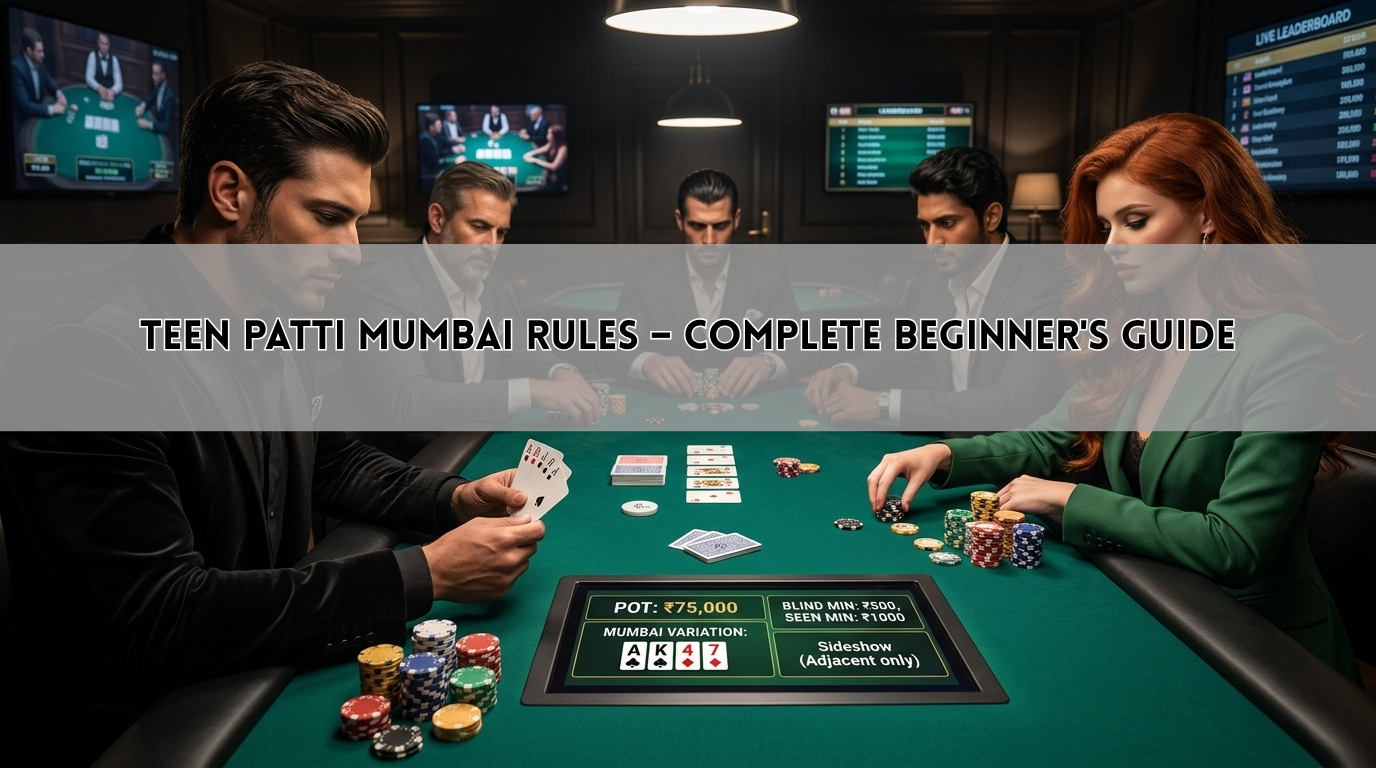
Teen Patti Mumbai Rules – Complete Beginner’s Guide
Understanding Teen Patti Mumbai rules is the first step to winning big money on online card platforms. If you want to play three-card games with real cash stakes without getting confused at the table, you are in the right place, boss.
We at Teen Patti Stars welcome you to the fast-paced world of local card games. Whether you are chill scenes with friends during Diwali or taking a shot at real cash games online, the Mumbai variation of Teen Patti brings extra spice, aggressive betting, and quick decisions. In this comprehensive guide, every single rule, variation, hand ranking, and winning trick is broken down so you can play like a seasoned pro without any tension.

What is the Teen Patti Mumbai Variant?
Teen Patti is often called 3 Patti or Indian Poker. It is played across homes, club tables, and mobile screens in every corner of India. While the standard version follows classic rules, local card hubs in Mumbai developed specific custom variations to speed up the action and increase total pot sizes.
The core game of Teen Patti is governed under general skill-based card traditions, while Indian legal frameworks regarding real money gaming are referenced under the Public Gambling Act, 1867.
In the Mumbai variation, game rounds move faster. Wild cards (Jokers) are added, and special pot-splitting conditions are used. Blind players get specific advantages, while Seen players face higher betting demands. When these local twists are understood by you, every card dealt turns into a high-stakes moment.
Basic Concepts and Teen Patti Mumbai Rules Explained
Before diving into advanced strategies, the fundamental Teen Patti Mumbai rules must be mastered by every new player.
| Step | Gameplay Stage | Details |
|---|---|---|
| 1 | 🃏 Card Deck | 52-card deck with no standard jokers |
| 2 | 💰 Boot Amount | Forced ante contributed before the round begins |
| 3 | 🃏 Deal 3 Cards | Each player receives 3 cards face down |
| 4 | 🎯 Player Decision Phase | Players choose how they want to continue |
| 5A | 👁️ Blind Play | Player does not view cards; plays according to the current bet |
| 5B | 👀 Seen Play | Player views cards; minimum bet is typically 2× the current blind bet |
| 6 | 🏆 Showdown / Sideshow | Players compare hands or request a sideshow when applicable |
| 7 | 💵 Winner | The winning hand takes the pot |
1. The Deck and Table Setup
- Deck Size: A standard 52-card deck is used. Wild cards or standard physical Jokers are set aside unless a specific Joker variation is declared before the deal.
- Player Capacity: Typically 2 to 6 players sit at a single table.
- The Boot (Ante): An equal minimum coin value is collected from every player before any cards are dealt. This forms the central pot.
2. Deal and Player Status
Three cards are dealt face down to each player in a clockwise direction. Once your cards are delivered, two choices are available to you:
- Blind Player: Cards are left face-down on the felt. You place bets without looking at your hands. Your bets are smaller (50% of what Seen players must put in).
- Seen Player: Cards are picked up and viewed. Since your hand value is known to you, your minimum required bet is double the current Blind stake.
Detailed Hand Rankings in Teen Patti Mumbai Rules
To make winning decisions during a match, card hand strength must be identified immediately. From highest to lowest, the official hand rankings under Teen Patti Mumbai rules are structured as follows:
| Rank | Hand | Example / Description | Strength |
|---|
| 1 | Trail / Trio (Three of a Kind) | A-A-A (Highest) → 2-2-2 (Lowest) | 🥇 Highest |
| 2 | Pure Sequence (Straight Flush) | A-2-3 or A-K-Q of the same suit | Very High |
| 3 | Sequence (Straight / Run) | A-2-3 or A-K-Q of mixed suits | High |
| 4 | Color (Flush) | Any 3 cards of the same suit | Medium-High |
| 5 | Pair (Two of a Kind) | A-A-K (Highest) → 2-2-5 (Lowest) | Medium |
| 6 | High Card | Highest individual card, from Ace High down to 7 High | Lowest |
1. Trail or Trio (Three of a Kind)
Three cards of equal numerical rank.
- Highest: A-A-A
- Lowest: 2-2-2
2. Pure Sequence (Straight Flush)
Three consecutive cards belonging to the exact same suit.
- Highest: A-2-3 (or A-K-Q depending on table rules; in Mumbai rules, A-2-3 is usually rated highest)
- Lowest: 4-3-2 of the same suit
3. Sequence (Normal Run / Straight)
Three consecutive cards belonging to different suits.
- Highest: A-2-3
- Lowest: 4-3-2
4. Color (Flush)
Three non-consecutive cards of the same suit. If two players hold Color, the hand with the highest-ranking card wins.
- Example: K-10-4 of Hearts beats J-9-8 of Hearts.
5. Pair (Double)
Two cards of equal rank paired with one unmatched card (the kicker).
- Highest Pair: A-A-K
- Lowest Pair: 2-2-3
6. High Card
When no combination or sequence is formed, the single highest card determines the value. If the highest card is tied between two players, the second card is compared, followed by the third.
Gameplay Mechanics: How a Round Proceeds
Every hand follows a strict sequential flow under Teen Patti Mumbai rules.
Gameplay Mechanics Flow
| Step | Gameplay Stage | Description |
|---|---|---|
| 1 | Boot Collection | All players make a forced contribution to the pot. |
| 2 | Card Distribution | Each player receives 3 cards face-down. |
| 3 | Betting Rounds | Players can call, raise, fold, or request a sideshow. |
| 4 | Showdown | The final 2 players compare their hands, and the winner claims the pot. |
Step 1: Collecting the Boot
Before card distribution, the table boot amount is automatically deducted. If the boot is set at ₹10, and 5 players sit at the table, ₹50 enters the pot immediately.
Step 2: The Action Phase
Starting clockwise from the dealer’s left, actions are taken in turn.
- Chaal: A player places money into the pot to remain active.
- If playing Blind, you pay the current stake amount.
- If playing Seen, you pay twice the current stake amount.
- Pack (Fold): Your hand is discarded, and active participation in the current pot is surrendered. Money previously bet is lost.
- Raise: The current stake is increased. The new higher amount becomes the standard requirement for all subsequent players.
Step 3: Sideshow (Compromise)
When two Seen players are seated next to each other, a Sideshow can be requested by the current bettor.
- The player asking pays the current Chaal amount.
- The requested player can Accept or Decline.
- If accepted, cards are privately compared between both players.
- The player with the lower hand ranking must Pack immediately.
- If hands are identical, the player who requested the Sideshow must Pack.
Step 4: Showdown (Show)
A Show occurs when only two players remain in the hand:
- Blind vs Seen: A Blind player can call for a Show by paying the current stake, regardless of whether the Seen player agrees.
- Seen vs Seen: Either player can call for a Show by paying double the current stake amount.
- Both hands are revealed face-up. The player with the superior hand ranking according to Teen Patti Mumbai rules claims the entire pot.
Popular Mumbai Variations Played Online
The Mumbai variation is famous because local house rules can be flipped on demand. On modern platforms, these variants are integrated seamlessly. Detailed updates regarding these variants can be explored in our Blogs section.
Popular Mumbai Variations
| Variation Name | Core Mechanic |
|---|---|
| Muflis (Lowball) | Weakest hand wins; for example, 3-2-7 beats AAA. |
| AK47 | A, K, 4, and 7 cards act as universal Jokers. |
| Joker / Wild Card | A randomly drawn card makes matching cards wild. |
| 10-20-30 Pot Limit | Bets are capped to help control table variance. |
| Revolving Joker | The dealer changes the wild-card rank after every round. |
1. Muflis (Reverse / Lowball)
In Muflis, classic ranking logic is inverted completely.
- The lowest-ranked standard hand becomes the absolute best winning hand.
- A hand of 3-2-7 (High Card) beats an A-A-A Trail.
- If two players hold Pairs, the lower Pair wins (e.g., 2-2-5 beats K-K-4).
2. AK47 Variant
In AK47, all Aces, Kings, 4s, and 7s are designated as wild cards (Jokers).
- If any of these four cards are held by you, they can substitute for any rank or suit needed to complete a Trail or Pure Sequence.
- Aggressive betting is common here because strong hands are created almost every round.
3. Lowest Card Joker
In this variation, three cards are dealt to you, and whichever card holds the lowest numerical rank in your hand automatically becomes your personal Joker.
- Example: If 10-10-3 is held by you, the 3 converts into a Joker, turning your hand into a 10-10-10 Trail!
Comparing Standard Teen Patti and Mumbai Rules
To avoid confusion during online matches, key differences are outlined below:
| Game Feature | Standard Teen Patti Rules | Teen Patti Mumbai Rules |
| Pace of Play | Moderate, classic betting rounds | Fast-paced, quick blind adjustments |
| Wild Cards | None by default | Frequently used (AK47, Low Joker, Muflis) |
| Sideshow Rules | Universal across all positions | Strict adjacent-player requirements |
| Betting Caps | Pot limit or No-limit tables | Strict pot-multiplier limits per turn |
| Blind Strategy | Used for 1-2 rounds maximum | Extended blind play encouraged |
Strategic Tips to Win Real Cash under Teen Patti Mumbai Rules
Winning consistently requires disciplined gameplay, sharp focus, and strict bankroll management. When real money games like Teen Patti or Rummy real cash are played by you, these practical strategies should be implemented:
Strategic Playbook
| Strategy | Action | Purpose |
|---|---|---|
| Play Blind Early | Play unseen in the early rounds | Controls costs and puts pressure on Seen players |
| Manage Bankroll | Never stake more than 2% of your total balance per hand | Limits losses and protects your bankroll |
| Target Sideshows | Use sideshows against mid-tier hands | Helps eliminate weaker opponents before the Show |
| Avoid Bluffs | Bluff rarely on high-stakes wild-card tables | Reduces unnecessary risk in expensive rounds |
1. Master the Blind Game
Playing Blind keeps your betting expenses low while forcing Seen opponents to deposit double your amount to stay active.
- Play blind for at least 2 to 3 rounds when table stakes are low.
- Fold early if Seen players double-raise aggressively before your turn.
2. Maintain Strict Bankroll Limits
Never enter high-stakes rooms without an adequate balance reserve.
- A healthy rule of thumb: Your total session bankroll should equal at least 50 times the table boot amount.
- If a table has a ₹10 boot, a balance of at least ₹500 should be maintained.
3. Use Sideshows Strategically
Requesting a Sideshow against an aggressive player on your right helps eliminate second-best hands early.
- Request a Sideshow whenever a medium Pair (e.g., 8-8-K) or high Sequence is held by you.
- If a Sideshow request is declined by an opponent, it often signals weakness, allowing you to pressure them with higher raises.
4. Observe Opponent Betting Patterns
Notice how fast opponents take their turns.
- Immediate raises often indicate strong hands (Trail or Pure Sequence).
- Pauses followed by minimum calls usually indicate weak Pairs or High Cards looking for cheap shows.
Safe Gaming & Legal Landscape in India
When participating in real-cash card games, security and compliance are paramount.
Indian Legal & Safety Framework
| Area | Key Law / Authority | Main Points |
|---|---|---|
| Central Legislation | Public Gambling Act, 1867 | • Prohibits operating or maintaining certain offline gambling houses • Traditionally distinguishes gambling activities from games of skill |
| Legal Precedents | State-level & High Court rulings | • Courts have distinguished games of skill from games primarily based on chance • Relevant rulings can affect how gaming activities are treated in individual states |
| State-Level Rules | Individual state laws and regulations | • Online gaming rules can vary by state • Players and operators should check the laws applicable in their state |
| Safety & Compliance | Licensed / compliant platforms | • Look for transparent terms and conditions • Verify applicable licensing, age restrictions, responsible-play policies, and payment security |
Under central Indian laws like the Public Gambling Act, 1867, running commercial gambling houses is restricted, but skill-based card gaming formats operate under regulated state frameworks.
Modern platforms employ certified Random Number Generators (RNG) and 256-bit encryption protocols to ensure every hand dealt is 100% fair and secure. If you ever have questions regarding account verification, payouts, or security protocols, feel free to visit our Contact Us page for 24/7 assistance.
Quick Getting-Started Checklist for New Players
Ready to test your skills on live tables? Follow this quick checklist to get started:
- Verify Hand Rankings: Memorize the difference between Pure Sequence and normal Sequence.
- Choose the Right Table: Pick a table with boot limits that match your comfort zone.
- Practice Blind Controls: Learn when to flip from Blind play to Seen play.
- Download the Official App: Ensure you are playing on a secure, certified client. You can Find out more details on official game features before starting your first session.
Frequently Asked Questions (FAQs)
What are the core Teen Patti Mumbai rules every player must know?
Teen Patti Mumbai rules mandate a standard 52-card deck where each player receives three cards. A forced boot amount is collected before dealing. Players can choose to play as Blind (cards unrevealed, paying base bet) or Seen (cards revealed, paying double bet). Hand rankings follow Trail, Pure Sequence, Sequence, Color, Pair, and High Card order.
How does the Muflis variant work under Teen Patti Mumbai rules?
In the Muflis variation under Teen Patti Mumbai rules, hand rankings are completely reversed. The lowest standard hand wins the pot. For example, a High Card hand like 3-2-7 beats an Ace Trail (A-A-A).
What is the difference between Pure Sequence and Sequence in Teen Patti Mumbai rules?
A Pure Sequence consists of three consecutive cards of the same suit (e.g., 5-6-7 of Hearts). A regular Sequence consists of three consecutive cards of mixed suits (e.g., 5 of Hearts, 6 of Spades, 7 of Clubs). A Pure Sequence always beats a normal Sequence in Teen Patti Stars tables.
Can a Blind player ask for a Show against a Seen player in Teen Patti Mumbai rules?
Yes, under Teen Patti Mumbai rules, a Blind player can request a Show against a Seen player at any point during a two-player showdown by paying the current single stake amount. The Seen player must accept the Show.
What happens if two hands are tied during a Show in Teen Patti Stars?
If two players reveal hands of identical rank and value during a Show in Teen Patti Stars, the player who paid for and requested the Show loses the pot. The player who was challenged wins the entire pot.
What is the AK47 variant under Teen Patti Mumbai rules?
Under Teen Patti Mumbai rules, AK47 is a popular variation where all Aces, Kings, 4s, and 7s act as universal wild cards (Jokers). Players can use these cards to complete higher-ranking combinations easily.
How does a Sideshow work in Teen Patti Stars games?
In Teen Patti Stars games, a Sideshow can be requested by a Seen player to the active Seen player sitting immediately to their left. If accepted, both players privately compare cards, and the player with the lower-ranked hand must fold immediately.
What is the minimum bet required for a Seen player in Teen Patti Mumbai rules?
According to Teen Patti Mumbai rules, a Seen player must bet at least double the current Blind stake. If the Blind stake is ₹10, the Seen player’s minimum Chaal must be ₹20.
Are Teen Patti Mumbai rules different from traditional Teen Patti rules?
Yes. While standard Teen Patti rules focus on basic hands without wild cards, Teen Patti Mumbai rules often include custom wild-card variations (like AK47 or Low Joker), faster betting structures, and flexible Blind playing options.
How can beginners practice playing under Teen Patti Mumbai rules safely?
Beginners can practice by joining low-stakes tables or free-chip tables on Teen Patti Stars. This allows you to learn hand rankings, master Blind vs Seen strategy, and test custom Mumbai variations without risking large amounts.
Join the Action Today – Claim Your 100% Bonus!
Now that you have mastered Teen Patti Mumbai rules, it is time to step up to the tables, boss! Experience real-cash tables with instant UPI withdrawals, military-grade security, and 24/7 customer support.
Click to Play Now on your browser or Download Now to install the official APK on your mobile device and claim your 100% Cash Bonus on your 1st Deposit immediately!